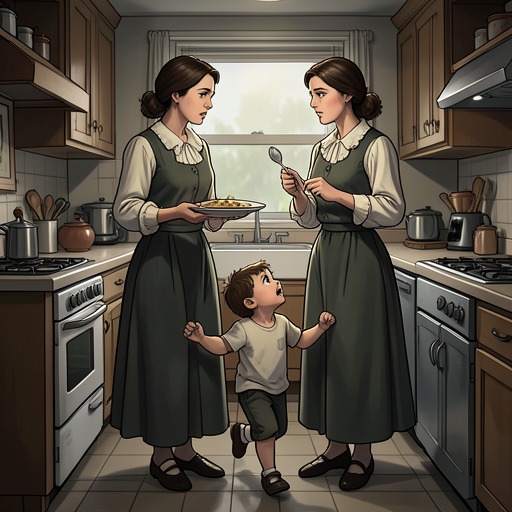
Lara Jean and Kitty’s sisterly bond
P.S. I Still Love YouLara Jean Song Covey and Kitty Covey’s sisterly bond takes shape less through grand declarations than through acts of attention: noticing when the other is uncomfortable, making room for a confidence, and standing beside her when a small conflict becomes personal. Their closeness belongs to a family changed by their mother’s absence, but it is also playful and practical. At the spring fair, Kitty’s defense of Lara Jean over a cake makes their private loyalty unmistakable.
Attentiveness and Private Confidence
At a gathering with girls, Lara Jean expects Kitty to be at ease, but notices that she is hanging back, playing with Jamie Fox-Pickle rather than joining in. Lara Jean has dressed for the occasion in a pale pink peignoir and put her hair in rollers; she has prepared mud packs and offered to set the other girls’ hair, though they refuse. Amid the noise and activity, she recognizes that Kitty’s apparent presence is not the same as having fun. She catches Kitty before she can slip away and asks her directly, then uses their sisterly promise as an invitation to speak honestly.
Kitty explains that Shanae has become close with Sophie and that the two girls matched their manicures without asking Kitty to join them. The injury is specific and small enough to be easy for others to overlook: the matching nails make visible a friendship from which Kitty feels excluded. Lara Jean’s attention gives the hurt somewhere to go. She does not dismiss Kitty’s distress because the occasion seems cheerful; she sees the difference between the party’s bustle and her sister’s unease, and asks for the truth rather than accepting a quick nod.
The household’s care for Margot Song Covey offers a wider view of how the sisters live out concern for one another. When Margot is upset after learning that her breakup with Josh is final, Lara Jean prepares Night-Night tea with honey, as their mother used to make it, and sends Kitty upstairs with the mug. Kitty balks at the idea of cuddling Margot and proposes bringing Jamie instead; when Lara Jean later goes to Margot with cinnamon toast, Kitty and the dog are no longer there. Lara Jean sits beside Margot and comforts her. In another private conversation, Margot makes space for Lara Jean to speak freely about Peter Kavinsky and Josh, and the two sisters link pinkies in a sisterly pledge. These moments center Lara Jean and Margot, not Kitty, but they show the family pattern of care and confidence within which Lara Jean and Kitty’s bond is formed.
The Family They Share
The sisters’ closeness is shaped by their mother’s absence without being reduced to it. While planning a chocolate cake for the elementary school cake walk, Lara Jean remembers an optional mother-daughter tea at school that she wanted to attend. She could have asked Grandma, as Margot had for some other events, but it would not have been the same. Lara Jean does not say that Kitty is troubled by such absences; instead, she acknowledges that the memory remains with her and considers what Kitty may be missing without assuming how Kitty feels.
That awareness gives an added tenderness to Lara Jean’s effort over the cake. Kitty has promised the PTA that Lara Jean will bake one on Kitty’s behalf. After Shanae’s mother describes making do with cake mix or a store-bought cake, she jokingly calls Lara Jean Teen Mom of the Year. Lara Jean laughs, then feels newly motivated to make an especially good cake so that people will know what Kitty has to work with. The cake is her contribution, but the attention behind it is directed toward her younger sister: Lara Jean is proud to make something that represents Kitty well.
Trina Rothschild later puts the sisters’ connection into words while talking with Lara Jean about family. She says that a girl’s relationship with her mother is important, but that sisters belong to one another for life. Trina recalls visiting her own older sister, Jeanie, when she misses their mother, because Jeanie increasingly resembles her. Her reflection connects sibling closeness to shared memory and loss. Lara Jean’s response is emotional: the conversation brings her own family into view, including the sisters who remain beside one another as they grow up.
The Cake Walk and a Public Show of Support
The spring fair’s cake walk gives the bond a comic, concrete test. Lara Jean volunteers to control the music and makes a playlist of songs about sugar. She has planned a chocolate cake with elaborate frosting, and the cake she brings has caramel. The game’s appeal to her is partly its uncertainty: children walk around numbered spaces while music plays, and a number chosen at random determines who gets the cake. The result is not supposed to be negotiated according to preference; the winner takes the cake attached to the number where they were standing.
When the music ends, Kitty and Owen come to claim their cakes. Owen has Lara Jean’s caramel cake, and Peter Kavinsky says he does not want that one, although he had told Lara Jean to get it. Kitty points out that the rules do not allow him to choose a different cake. Peter protests, but Kitty moves closer to Lara Jean and refuses to give way. Her intervention is direct and brief; it turns the rules of the game into a boundary that protects her sister from being pressured.
After Peter and his brother leave, Lara Jean hugs Kitty from behind. She had been uncertain about what Kitty was doing at the fair, but Kitty has made her allegiance plain. Lara Jean’s embrace answers that support physically, and the thought that Song girls stick together gives the moment its family meaning. Kitty is not merely enforcing a game rule: in this exchange, she stands with Lara Jean when the disagreement involves Peter, making their bond visible to the people around them.
Shared Rituals and Sisterly Continuity
The relationship also has a teasing, exuberant side. After a pancake breakfast, Daddy remembers that another of his daughters has a birthday coming up and begins singing Sixteen Going on Seventeen. Lara Jean takes Kitty’s hands and spins her around the kitchen, joining the song rather than letting the moment remain a performance by their father alone. Daddy marches in place and sings another line; Kitty interrupts to call the song sexist, and Lara Jean dips her. The exchange holds disagreement and play together: Kitty can challenge the song while still joining the family ritual.
Across these scenes, Lara Jean’s care for Kitty is attentive rather than controlling. She asks whether Kitty is enjoying herself, makes room for her account of feeling excluded, and does not claim to know what her sister thinks about their mother’s absence. Kitty, in turn, answers that care with practical solidarity at the cake walk. Their connection is sustained by small gestures—an invitation to confide, a carefully made cake, joined hands in a kitchen, an embrace after a public disagreement—and by the larger family truth that sisters share a history and remain part of one another’s lives.